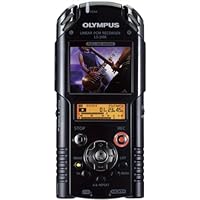
 I have had the chance to check out the LS-20M recently and compare it to the Zoom Q3 HD and Olympus audio recorder LS-11.
BUILD: The LS-20M has a more solid feel than the plasticky Zoom, but I sure wish the LS-20M had an all metal chassis like the LS-11, which feels weighty and much more durable. I like the all button approach of the Zoom and LS-20M, as opposed to the dials for the levels and volume control on the LS-11. I am one of those that feel the less moving parts, the better. I would like some kind of protection for the lens on the Zoom and LS-20M. They seem exposed and liable to scratching.
DESIGN: The camera of the LS-20M is placed right on the top of the unit between the microphones. Seems to be designed for tabletop use. Or perhaps journalistic/interview purposes, where you hold the unit towards an interviewee like a microphone and you can get a decent video at the same time(although with such a viewpoint from below the subject would look unflattering). I intend to use the LS-20M for recording gigs and rehearsals so the position of the camera in relation to the LED screen for this purpose is awkward, and I find the Q3 HD easier to set up and work with in this regard. The big disadvantage with the LS-20M design, as noted by the other reviewer, is that you can't use any type of wind blocker otherwise it would cover up the lens. The Zoom design is definitely better here.
OPERATION: I found the buttons, menus and functions of both the Zoom and LS-20M are fairly intuitive and easy to navigate, similar to a smart phone. Its probably even possible to operate all functions of the LS-20M with just one hand. I really prefer the total manual audio level control of the Olympus units as opposed to just the 'hi and low' settings of the Zoom.
FILES: My biggest complaint with the LS-20M is that after the max 4GB per file is reached the recorder does not automatically start another file for continuous recording like the LS-11. I haven't recorded anything on the Zoom long enough to see if it creates a new file or not. The Olympus LS-10 had this problem and was addressed with a firmware update, and the LS-11 didn't have this problem at all. I am hoping that this is something that may be fixed on the LS-20M with a similar firmware update.
VIDEO: I have only done a few hours of testing with the LS-20M, but based on what I've seen the video quality of the LS-20M is far and away much better than the Q3 HD. The Zoom video is very noisy, artifacty and jittery, but the LS-20M is much cleaner, 'richer' and smoother with some noise in low light. I recorded a backyard gig during the 4th of July weekend and the image seemed to get 'wavy' whenever I hit certain notes on my bass. Not sure if this was from the tripod vibrating when I hit the note or if it was something inside the LS-20M doing it. Here is a video link of this curious phenomenus: youtube dot com/watch?v=GH51yq0WvmE
AUDIO: I have always liked the audio quality of the LS-11 over the Zoom, so much so that I would record with both the Q3 HD and LS-11 and replace the Q3 HD audio with the LS-11 audio in post. Since the LS-20M has similarly excellent audio, at first I thought I could get rid of both the LS-11 and Q3 HD. But with the aforementioned wind blocker problem, it looks like I will be holding on to the LS-11 (with wind blocker) and replacing the audio again if there is excessive wind noise on the LS-20M.
BATTERIES: I usually use a power adaptor for audio/video units like the Zoom and LS-20M. That being said, I haven't been able to test the charge life of the rechargeable battery that comes with the LS-20M. The Zoom uses two AA batteries and sucks them dry in less than an hour. Since the LS-11 is audio only, the two AA batteries last several hours and with lithiums can last over 15 hours.
ACCESSORIES: Accessories include the rechargeable battery, 2GB SDHC card and power adaptor (the Q3 HD power adaptor is an annoying separate purchase, and the battery life of the LS-11 is very long so I don't use a power adaptor). The LS-20M didn't come with a carry pouch like the LS-11 did, and the grammar of the users manual is sort of dodgy.
CONCLUSION: Overall, so far I like the LS-20M very much and immediately sold my Zoom Q3HD. Olympus has great audio and video quality with the LS-20M, but its the design of the unit that seems to be the major weakness. I am hopeful of design improvements for future versions of this unit, and a firmware update to address the continuous file problem of the LS-20M.

First the good...audio quality is very good as I expected and video quality is also very good to outstanding. I used the LS-20M to record a performance by a band in a small venue and the results were very good. Image quality was great and sound quality blew away that of my video camera without an external mic. In the small club, the LS-20M's zoom was plenty to frame the stage nicely but I had great views of the stage and little blocking my view. Essentially, the product performed as advertised. Another plus is size. If you need to record and don't want to draw a lot of attention to yourself, this camera is a great choice as it's not that much bigger than an iPhone but longer and can be easily carried in a jacket pocket and concealed when not in use.
Now for the not-so-good...the lens placement is funky for sure. I shot nearly all of a one hour set and my arm was indeed worn out from holding the camera at the funky angle necessary to capture the performance. I would hope that future versions of this model come with a way to adjust the camera lens--that would have been a huge plus on this release. For whatever reason, Olympus did not see fit to provide us with a case for the LS-20M out of the box. I'm going to try the CS-117 Carrying Case for the LS-10 which I think will be a suitable alternative. Lastly, the shell of the recorder is made of plastic. It survived being dropped the first night from about 3 feet with no scratches but it doesn't feel as sturdy as the LS-11 (which has an all-metal body).
All in all, I'm satisfied and I'm going to keep the LS-20M however I can't help feeling that the next iteration of this recorder is really going to be the one to get.
Buy Olympus LS-20M HD Video/Audio Recorder Now
I have only had this camera for about 25 days, and thank goodness I discovered this problem within my 30 day window, as it is being returned today. First, there are many positive things I could say about this device, but I feel many other reviewers sum them up very accurately. However, one defect has yet to be discussed. I purchased the LS-20M to record classical performances (such as solo piano, or piano with another instrument). I recorded using a tripod, without any movement from the camera (no panning, zooming, etc). The camera seems to shoot fine when there is consistent movement of some kind in the whole picture. Then I noticed a very obvious "digital distortion" of the image, which seemed to only occur when there was either no motion in the frame or very little motion. I am sure there is some term or further explanation for what is going on, but that is the best I can do to describe it. I have uploaded a short sample to accurately show what I am talking about:www. youtube. com/ watch?v=AtUzBRdoEYk (remove spaces)
I did go through every single possible setting (image stabilizer, image quality, ISO, etc.) trying every single combination and nothing solved the problem. UPS should be picking it up today......
FYI the max file size is 4 GB regardless of quality settings. So at 1080p that's about 40 minutes of continuous recording. I hadn't seen this mentioned anywhere, expect when I found it towards the end of the manual.
Read Best Reviews of Olympus LS-20M HD Video/Audio Recorder Here
On the move I have always needed a high quality stereo SD recorder. I have been through a variety of handheld 24bit 96KHz recorders from the likes of Tascam and Zoom, recently progressing through the Zoom Q3 and then the 90% there Zoom Q3HD. Having great stereo capture with the option to capture so-called HD is very attractive. It is impossible to find a budget HD Camera with the ability to input from a high quality mike or desk even then you are carrying around a lot of bits and wires etc: So the Audio focused device with Video as a bonus is my favourite. So when Olympus announced the LS20M I promptly sold my Q3HD and waited with baited breath. I have only had the device a few days but can give some top line reviews.PROS the interface is much better than the Zoom, it feels like a camera with built in great sound rather than an audio recorder with a lens built in, the image quality on locked off shots is much better than many of the HD handheld hybrids (on my LG 60inch TV!), it is great to hold (tiny) and operate, the sound beats my Rode NT4 and other dedicated low end mic pairs for ambient and close range sound based on 1 test, and being able to use a longer lead for USB to Mac transfer is great, tripod mounting on the large under flat surface is weird at first but great after a while if the device is below you.
CONS the video display is tiny and off axis by a few degrees can hardly be seen (even indoors low light impossible outdoors), as the lens is pointing forwards from the body it is a nightmare to get eye level shots of people (this is meant to be used table mounted you can reverse the image and hold it above your head pointing down but that feels really odd!), most outdoor on the move shots tend to be held at waist height producing unflattering people shots, the mics are flush with the body so it looks impossible to put wind blockers on them meaning all sound in the slightest wind is popping (this is a useless device without some form wind shielding outdoors on a slightly windy day), the file system is old school folders hierarchy and numerical file names, handling during video taking is very shaky as it is so small and you have to hold it across the body which seems to amplify movement.
OVERALL I would say it trumps the Zoom Q3HD, just! Perhaps 91% in my book. A lot of changes required to make this truly usuable in both audio and video departments, that said image quality is great (as long as you don't digi zoom!), and its form factor means top pocket of suit potential. If the front lens was rotatable to point forwards AND there was windshield protection on the mikes AND the screen was visible from more than directly above this would get close to 95% and lead the field in these hybrids...
Want Olympus LS-20M HD Video/Audio Recorder Discount?
I have had this recorder a week and may update after more experience but here are some initial notes. If you have a LS-10 do not expect the nice looking metal body, expect not near as nice plastic, but it gets the job done. The menu works fine for me, easy to use after a small amount of time invested. The lens zooms from "wide' to digital 4x telephoto. "Wide" is a misnomer, it is about the equivalent of a 60mm lens on a 35mm camera. The digital zoom quality is useable with good light. Lens placement is OK with me given it is a combo high quality sound recorder as well as video it makes sense for the lens to be between the microphones.What sucks big time is the short battery life. I would say 45 min to an hour using it for video. I have charged it three times, perhaps performance will improve after a few charge cycles but I have my doubts. Plan on buying spare batteries and the charger if you plan to use this recorder for much video. Also you do not just plug it into charge, you must go into a menu and tell it if it is being charged thru the 110v / usb adapter or to a computer. After you plug it in you must then hit OK to tell it to charge. Battery is why it only has 3 stars.


No comments:
Post a Comment