 The review below has been updated to cover both the Anker 10000 mAh battery pack and the Anker 20000 mAh battery pack which are both sold on the same page. The review for the Anker 20000 mAh unit is listed below the Anker 10000 mAh review and was added as an update on 3/14/2013. The video shown on the left side covers only the Anker 20000 mAh unit. If you have any questions please contact me.
+++++++++++++++++++
This is a review of the universal power bank model MP 10000. It is a rechargeable power pack that will carry a 10,000 mAH charge to allow it to recharge almost all of your portable devices.
When it is plugged in and charging there are four blue LED circles on the front panel and they are in order flashing from left to right 1, 2, 3 and four (all lit up) and then they shut off and cycle again. The unit comes with a separate charger adapter which is 12 V DC at one amp. The addition of a charger is a nice touch as some vendors do not include a charging device with their battery pack and expect you to use your computer or your existing wall charger from one of your devices to charge the battery. I plugged the device in to charge it not knowing how strong the existing charge was. I wanted to make sure that before I did any testing I had a fully charged unit and I wanted to see how long it will be before all the LEDs turn off to indicate a full charge. It took one hour to top off the battery before the LEDs went out.
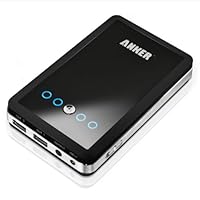
The unit is nicely packaged and is beautiful in design. The front of the battery pack has a nice glass like finish and it actually looks like a large iPhone. The photos don't do it justice as the appearance it well designed. It does carry a 10,000 mAH charge which is quite substantial and is adequate to charge even an iPad or an iPad 2 or the new iPad 2. The weight of the product is 304 g which is the equivalent of 10.72 ounces.
The battery pack device is designed to charge other items requiring power of 5 V, 9 V, and 12 V. after using the battery pack all night to recharge an iPad 2 new version, the battery pack only took a little over 3 hours to recharge from 1 LED of capacity remaining. That is quite fast as other devices I have tested have taken considerably longer.
There is a switch on the side of the battery which allows you to select between 9 V or 12 V DC and whichever voltage is selected that value shows up on one of two small red displays that indicates 9 V or 12 V. There is a small round jack labeled "Output" and can be used to charge a device that may require those voltages. This capability greatly expands the versatility of his battery pack to allow it to charge many other devices. Unfortunately the very poor instruction manual does not even tell you the polarity of the output connectors. My test indicated that the center pin is the positive for the DC voltage while the outer connection is negative.
The unit has three output ports to charge items. There are two USB ports rated at 5 V DC at 2.1 Amperes. There is also a DC voltage output plug rated for either 9 V or 12 V DC at 2 Amperes as previously disclosed. One USB port is labeled "Out S" and is noted that it is made for charging a Samsung PE 1000 notebook. The other USB port's is named "Out I" as designated it is a charging output for the iPad series of products. There obviously is a wiring difference between the Samsung and Apple iPad devices. Make sure that you plug your device to be charged into the proper USB port. My iPad 2 would only indicate that it was getting power by utilizing the port labeled "Out I". My iPhone 4 would charge while using either of the two USB power output ports. My Kindle Fire would charge from both of the USB ports also an iPod touch version 4. Unfortunately the HP Touchpad would not recognize the "S port" and the "I port" made the Touchpad present a message that the charging device either did not offer enough voltage or current and as a result it may not charge properly. HP uses a funny voltage to make sure you buy their charging adapters.
Make sure that when you begin charging your device that you press the "on" button after you plug your device into the battery. It doesn't automatically come on.
The device comes with 18 plug port adapters for various types of phones and other devices. It also includes three cables one is a USB to micro USB adapter cable, the second is a an extension cable that will accept some of the connectors for other devices and the third is a USB to cable to round adapter that will accept the balance of the device plug style connectors.
* I ran my new iPad 2 down to 41% and plugged it into port "Out I" and pushed the on button of the battery and the iPad began charging. All four of the Blue circular LEDs lit up as the battery was charging my iPad.
* At 30 minutes the charge level of the iPad was at 45%
* At 45 minutes the battery dropped to 3 LED lights
* At 60 minutes the charge level of the iPad was at 50%
* At 90 minutes the charge level was 54% on the iPad (3 LEDs on the battery pack)
* At 120 minutes at 58% on the iPad (3 LEDs on the battery pack)( but dropped to 2 LEDs out of 4 at 140 minutes)
* 150 minutes = 63% with 2 LEDs
* 180 minutes = 67% with 2 LEDs
* 210 minutes = 72% with 2 LEDs
* 240 minutes = 76% with 2 LEDs
* By 7 AM the next morning the iPad 2 new version was at 100% charge and only 1 LED would light.
* I was able to charge an iPod Touch from about 15% to full charge in under an hour!
The device comes with an instruction sheet but the English is so poorly written that I find it even difficult to read. There exist multiple errors in language and in technical details in the one page instruction sheet. Even though it was basically useless I did not subtract anything from my rating as the instruction sheet can easily be corrected and the product works well. It is definitely a problem that needs to be corrected though!
++++++++++++++++++++++++++++++++++++++++++++++++++++++++++++++++++
Update:
I have been advised by the distributor that the instruction sheet is being revised and it will ship with future orders. This is good news as it will make the user's experience with the product much better.
++++++++++++++++++++++++++++++++++++++++++++++++++++++++++++++++++
I was provided one of these devices to review by the vendor.
+++++++++++++++++++++++++++++++++++++++++++++++++++
Update 3-14-2013
This is the review portion for the Anker Astro Pro2 20000 mAh battery pack.
This battery pack is simply the most powerful rechargeable battery pack that I have ever tested. It is also the highest quality design and construction that I have seen in any battery pack. I was so impressed that I put together a video of the unit and the test results for your review.
The construction of this battery pack is simply beautiful. The exterior shell is brushed aluminum that looks fantastic. The battery is the size of a 7 inch tablet and it weighs in at 1 pound 4 ¼ ounces. It is assembled with machine screws and the overall construction is the best I have seen. The battery pack has a USB output port that outputs 5 VDC at 2.1 Amps. It can also output 12 VDC at 4 amps, 16 VDC at 3.5 Amps and 19 VDC at 3 amps to charge many laptop and netbook computers. There is a voltage switch to set the output voltage for specialty charging so make sure that you set it to match your needs of your device. This is important.
This is the first battery pack that I have seen that has enough power to charge an iPad 3 fully and in reality it could charge it 1.3 times according to my tests. I was able to charge my electronic devices for over 10 hours on a single charge of the battery pack which is amazing. Nothing I have ever tested has even come close to the performance of this battery pack. During the testing the temperature of the battery pack never even exceeded ambient room temperature. I used the USB port to charge my devices during this testing. To start your device charging connect it with the proper cable and power adapter, set the voltage if required and press the battery pack power button and charging starts. The charging will stop automatically when your device is fully charged or the battery pack is depleted.
There are 5 LEDs to indicate the amount of battery charge in the battery pack. Power levels are indicated by:
* One flashing LED is 1% charge
* 1 solid lit LED is 1% to 20%
* Two lit LEDs is 20% to 40%
* Three lit LEDs is 40% to 60%
* Four lit LEDs is 60% to 80%
* Five lit LEDs is 80 to 100 %
In addition there are three LEDs to indicate the voltage setting of the specialty voltage output. The Lithium Polymer battery can be recharged over 500 times during its life cycle and if you are a power user of a tablet, laptop or any electronic device then this is the battery pack to own. It comes with an 18 month warranty. The unit comes with a powerful AC wall charger that quickly recharges the battery pack. The specs claim that it can recharge the battery pack in about 3 hours.
This product is the best I have tested and I rate it at 5 stars. If you are a business person or a student and have to depend on your tablet or laptop for long periods of time without the ability to get to an AC power source then this is the battery to own.
Items in the box:
* Powerful AC wall charger adapter
* The battery itself
* A charging cable for your laptop and 10 different styles of laptops
* A phone charging cable
* 5 mobile phone charging adapters
* A user instruction manual
* The 18 month warranty card
Charging my devices:
I charged the battery pack fully before I started my test. I started with an iPad 3 charge at 21 percent and the Anker 20000 was at 5 LEDs.
* 30 minutes 29 percent and Anker at 4 LEDs
* 60 minutes 38 percent and Anker at 4 LEDs
* 90 minutes 47 percent and Anker at 4 LEDs
* 120 minutes 56 percent and Anker at 4 LEDs
* 150 minutes 64 percent and Anker at 3 LEDs
* 180 minutes 73 percent and Anker at 3 LEDs
* 210 minutes 81 percent and Anker at 2 LEDs
* 240 minutes 89 percent and Anker at 2 LEDs
* 270 minutes 95 percent and Anker at 2 LEDs
* 300 minutes 100 percent and Anker at 2 LEDs
I used the same battery pack without recharging it and I began charging a Kindle Fire which was at 53 percent capacity. The Anker was at 2 LEDs.
* 30 minutes 78 percent and Anker at 2 LEDs
* 60 minutes 92 percent and Anker at 2 LEDs
* 90 minutes 100 percent and Anker at 2 LEDs
I used the same battery pack without recharging it and I began charging an iPhone 4which was at 51 percent capacity. The Anker was at 2 LEDs.
* 30 minutes 80 percent and Anker at 2 LEDs
* 60 minutes 92 percent and Anker at 2 LEDs
* 90 minutes 96 percent and Anker at 2 LEDs
* 101 minutes 100 percent and Anker at 2 LEDs
I used the same battery pack without recharging it and I began charging an iPad 2 which was at 16 percent capacity. The Anker was at 2 LEDs.
* 30 minutes 31 percent and Anker at 1 LED
* 60 minutes 45 percent and Anker at 1 LED
* 90 minutes 58 percent and Anker at 1 LED
* 120 minutes 64 percent and Anker at 1 LED that was flashing indicating that it needed to be charged.
Limitations of device charging:
* iPhone 4 battery 1,420 mAh battery capacity
* iPhone 4S battery 1,432 mAh battery capacity
* iPad 2 battery 6,944 mAh battery capacity
* iPad 3 battery 11,560 mAh battery capacity
* Kindle Fire battery 4400 mAh capacity
* Kindle Keyboard battery 1750 mAh capacity
* iPhone 5 is 3.8 VDC at 5.45 Wh = 1434 mAh battery
* iPad 4 battery is 11,486 mAh 3.7 VDC at 42.5 Wh
* iPad Mini battery is 4490 mAh at 3.72 VDC 16.7 Wh
As you can see the Anker 20000 mAh will fully charge a totally dead iPad 3 or 4 because it contains 20000 mAh of capacity.
All of this from the first charge:
* 79% of an iPad 3 charge equals 9132.4 mAh.
* 47% of a Kindle Fire charge equals 2068 mAh.
* 49% of an iPhone 4 charge equals 695.8 mAh.
* 48% of an iPad 2 charge equals 3333.2 mAh.
* That equals 15229.32 mAh output over a 10 hour period and that is an output efficiency of over 76% on my first charge of the Anker 20000 mAh battery pack.
You have to consider the losses in the charging circuits of both the battery pack and the device you are charging so this result is outstanding! When using an external battery you have to allow approximately 30 % of the battery capacity will be lost to heat, voltage conversion, powering the batteries electronics and the electronics of your electronics device's charging circuits. In addition you have to consider that your device is not truly off like a cell phone is still connected to the WIFI and phone networks and probably receiving emails, etc. This is the most powerful rechargeable battery pack I have tested.
I received a sample product for evaluation and I promised to provide a fair and honest review.

It's approximately the size of a typical portable USB hard drive and the build quality is quite solid. The black portions are a matte, semi-rubberized surface while the top cover is glossy plastic. As many have said in other reviews, what may appear to be scratches in the glossy front is actually a protective film which can be removed with the aid of a piece of tape or a fingernail. I ended up leaving the film on mine to protect its surface. There's a silver power button which you use to turn the power pack on as well as four blue LEDs that indicate its charge capacity. There is also a switch to change the power output from 9V to 12V which I found particularly impressive since many of my camera battery chargers run on 12V. So in addition to charging my phone, I can use this to charge my camera batteries as well! Obviously everyone's gear is different, so your individual mileage may vary, but it was definitely a pleasant surprise to find out that this item works with such a wide variety of my gear!
Along with the pack, you get an AC adapter to charge it from a wall outlet as well as a whole galaxy of various charging tips and adapters that should fit any phone or device you may have. With the amount of adapters they include, I would be seriously shocked if you had a device that didn't work with it. In addition, compared to some of the older reviews, it seems that the included product literature and various information cards have gone through some revisions so they're now extremely easy to follow and very well-written. The inclusion of a small card indicating the protective film on the front leads me to believe that Anker is a company that responds to customers concerns which I find very impressive.
I won't go into precise charge times since I haven't had the time to put a stopwatch on it, and there are other reviews that get into this more in depth. But suffice it to say that this is a fantastic product from an excellent company and I look forward to doing business with them again.Ok, I know everyone before me has said that theres came scratched. I was no different, however, I didn't really care. This battery bank is awesome. I use it everyday to charge my PSP, and Cell Phone on the go. I am a college student and there are never enough outlets in the classrooms. Not a worry anymore. This little battery bank has worked wonders for me. Here is a secret. The scratches aren't on the actual product. I was fooled when I looked at it, but if you are one of those people that really cares about cosmetic scratches, here is a tip. Take a piece of tape, preferably electrical and really press it on any corner or end of the polished screen protector. Simply peel away and the polished look is underneath that film that looks scratched. I would recommend you leave it on though. Once you take it off than any scratches from there on will be permanent.
I ordered this product on a 1-Day delivery and I think it was worth every penny. If you need something that can charge two products at once and still have enough charge to power a laptop, this product is for you!
I highly recommend it.I'm an electronic engineer and I'm a little disappointed in the lack of useful and reliable information about this pack. After three full charge-discharge cycles, the pack is stable in its capacity, though significantly lower than what was rated by about 15%. That's too much.
First of all, the 10,000 mAh rating is misleading. They should give the Watt-hour rating instead, because you don't know what voltage the mAh rating corresponds to. If it's 5V, it's a lot. But no, they rated it at the LOWEST possible voltage rating to get the highest mAh figure. They used the 3.7V low-margin figure for the LiIon cell. (A LiIon battery discharges from 4.2V down to 3.7V and then dies rapidly. An accurate average is 3.9 or 4.0V. But that would have given them a mAh rating of only 9250mAh, not as impressive as 10,000mAh.)
So the rated capacity is 37Wh (from the owner's manual).
After three full cycles, I get a consistent capacity of 31.5 Wh. That's 8500mAh at 3.7V, to normalize it to their published figure in this product description on Amazon. I have a Polaroid portable DVD player that draws a consistent and exact 1A at 9V, and it's very easy to measure.
Anker, if you think I got a bad pack and want to replace it, please let me know by a comment here. If I can get a good pack within about a week, I'll buy a second one for a long plane flight that we're taking (to keep my kids occupied with movies). But 3.5 hours on a charge isn't even enough for 2 movies on this player. I was counting on at least 4 hours, which it would have done easily at 37 Wh.
I also don't like the capacity-meter lights. They turn off at the rate of about 1/2 hr for each of the first three, then the last one goes for 1.75 hours which makes them pretty useless. I would guess that instead of using a coulomb-counter battery "gas gauge" chip, they just measured the battery terminal voltage which is not only inaccurate and varies significantly between batches of batteries, it also changes as the battery ages and so becomes even less accurate.
Despite my criticisms of the rated capacity and battery meter, it's a good pack overall and I'm not going to return it unless Anker is confident they can meet the 37Wh rating. I've given it 4 stars because at 31.5Wh/8500mAh, it's still a good deal for the money, and appears to have good quality of design and construction. And for this class of pack to have both 5V AND 9V outputs is very convenient.I purchased the Anker Astro 3 10 A-hr battery to use as a backup for my iPad 3, which I am using as an "electronic flight bag" in an airplane. As in all aviation-related areas, a backup for critical items is necessary. I am, unfortunately, disappointed in the capacity of the battery, which seems to be well short of its specification.
The battery in the iPad has a 42.5 W-hr capacity and the Anker battery, which has a claimed capacity of 37 W-hr, should charge the iPad to 87% of its full charge. Instead, starting with 10% charge, the external battery charges the iPad to 73%, which suggests that it has a capacity of 27 W-hr. Of course, the percent scales on the iPad are probably not calibrated very well, but the telling point for me was that, while lightly using the iPad, it actually slowly lost charge when plugged into the external battery! It is almost certainly not providing the claimed 2.1 A output -the Apple charger (also rated at 2.1 A output) fairly rapidly charges the iPad during use. All of these tests were done after about 4 complete charge/discharge cycles and the last test was done while the Anker was showing 2 leds (about half charged).
I am returning the unit for a replacement and will upgrade my rating if the claimed capacity is met. In all other respects, the unit is fine.
Update: The second unit has the same problem: much less than expected capacity and inability to effectively charge an iPad 3 during use. I will return the battery and find one with greater capacity.
Here are my two objections to the unit:
1. As the vendor admitted, they are excessively optimistic about the capacity and don't include the inefficiency of the additional circuitry. Since all the battery makers do this, I suppose I could live with this.
2. Their claim of 2 A output current can't possibly be accurate. The iPad 3 has a 42 W-hr battery and a useful operation time (which I have confirmed) of 10 hours or so. This means it consumes about 4.2 W or a little less than 1 A from a 5 V battery. If the Anker battery supplied 2 A, it would definitely have enough left over to charge the ipad battery. Neither of my two units were capable of charging the battery with the iPad running in idle. With it sleeping, it took 8 hours or so to charge the iPad battery by 60%. Supplying 25 W-hrs (60% of 42) in 8 hours (3 W) suggests about .6 amps at 5 V. Again, much less than the spec. It seems to be providing
Save 58% Off

No comments:
Post a Comment