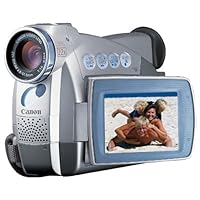
 I work with camcorders since 1988 S-VHSC, Hi8, etc. No question, no matter what kind of digital camcorder you compare with an analog one, it is superior. However, I found this camcorder particularly interesting and bought it since I left the `semi-professional' field (and being now an electrical engineer in software development). Here are my findings:
Pro:
1) Awesome workmanship: The high-grade plastic case pieces precisely fit and give the camcorder a valuable finish, the buttons have a well defined 'ignition' point and the connectors for FireWire, USB, Analog Video etc. are 'cemented' into the case.
2) Excellent cost / feature ratio: Although following the hype of marrying video with stills, this camcorder emphasizes on video (please, do buy a digital camera if you need digital stills). The outstanding optical unit with a real 22x zoom and one of the most effective image stabilizer in the market, combined with a friendly user-interface including illuminated buttons and a clean menu, this camcorder is a bargain.
The picture quality is excellent. One note here: please remember that the miniDV standard builds on 5.7 Mhz video bandwidth. In other words, no matter what the (multi) colored CCD ship is capable of a resolution, it comes down to a maximum of 370,000 effective pixels needed for NTSC video. The 460,000 pixels of this camcorder seem more than enough.
3) Accessories: Just in case you really care about the somewhat whining recorder server motors, please do buy the optional microphone it's an awesome addition if you do semi-professional sound-recordings. Also, Canon offers wide and tele-converters specialized for the ZR series. Not a novelty in camcording in general, but a serious affordable consumer expansion if needed.
4) Internationality: Yes, there are other electrical power systems out there: the Canon switching power supply is not only very light, it also connects to almost every wall-outlet in the world with the right (optional) plug-adapter.
5) Ergonomics: Oh yes, I thought about a palm-ready camcorder, too. But think about it: the optical unit including the lenses and the CCD has to fit into half the length of a regular camcorder like the ZR 50 (Palm recorders do not have more than 10x zoom, the ZR 50 has 22x). The camcorder fits right into my hand, the zoom button can be accessed naturally without shifting the camcorder in your hand (try Sony!) and the zoom button is depth sensitive the deeper you zoom, the less sensitive is the camcorder zoom-button. Additionally, beside so many other brands out there, the digital zoom is even useable to a certain degree. It becomes affective once the optical zoom is exhausted to a 22x. However, if you want quality video, turn it off.
6) Video Modes: Select one of the predefined video modes. One of the most impressive mode is the night-mode if the moon strikes you, your ZR 50 will catch it. However, don't expect wonders, every serious video-grapher recommends at least 100 lux (a unit of measuring light-intensity).
Con:
I couldn't find a con so far maybe the sound-quality the integrated microphone produces? Hm, given the size of the case, it seems reasonable...
Yeah, I am enjoying this camcorder. Canon showed once again that a camcorder design can meet almost all of a consumer-customer's needs:
Rich functionality, lightweight design, extensible through optional accessories including lenses, robust workmanship.
Recommended!

1) Motor noise pickup Yes, it is there. It is a somewhat higher-pitched whine that you can hear if your ear is close to the camera while recording. I bought the DM-50 mike and have now used the mike extensively, including taping my daughter's cello recital as well as a MS&HS spring concert which included vocals and a full Vivaldi concerto by a 15 member string ensemble. The DM-50 mike completely takes care of the motor whine. In addition, with the camera set at 16-bit recording, the recorded sound is CD quality. The DM-50 has three settings: boom, 1, and 2 (latter 2 are stereo). The best setting is the "1" setting.
2) General Impression The video is great. It is the sharpest of all the cameras I've owned so far. The camera is surprisingly small (half the size of the Hi8mm), but fits well in the hand. The outside buttons are very handy. The LCD viewer is easy to read and has true colors. The manual is comprehensive. The remote is multifunctional. The digital image stabilization works very well (as well as the optical stabilization of my older camcorder). The 22x optical zoom is excellent (I turned off the digital zoom). I was able to take good close-ups of the students at the spring concert (using a tripod). The auto focus is very fast and stable, better than previous camcorders. The camera is clearly not perfect, but for the price, it has a lot of highly desirable features.
3) Low Light PerformanceThis is not a strong point. The shutter speed for both low light and nightlight causes the images to be jerky when panning. I purchased the VL-3 light since it is powered by the camera battery. At 3 watts, it is not so obtrusive/intense as to be a huge problem for people looking at it. The light is very small, so it is easy to carry. The light is most effective within 6 feet or so. Outdoor video of spring flowers taken at night was fine.
4) Batteries I purchased the BP-535 battery which is quite large (in a relative scale sense). I used it to power the ZR50 during the 1 hr taping of the spring concert (and it powered the mike as well). When I was done, the indicator was showing 2/3 battery power still left.
5) BonusesA) The ZR50 uses the same power adapter/charger (CA-560) as the G2 digital cameraless to carry. B) The remote will also work on my other Canon camcorders which can be a problem if you're using both together. However, you can program the ZR50 remote to setting "2" to avoid this issue. Very thoughtful.
6) Still Images Have not triedhave excellent digital camera for that.
Finally, due to the small size, I can fit both the ZR50 camcorder and G2 digital camera with mike, light, flash unit, extra batteries, cables, etc. in a fairly small case. This is good.
Buy Canon ZR50MC MiniDV Digital Camcorder with 2.5" LCD, Digital Still Mode & MMC Card Slot Now
I read about the motor hum being recorded on Amazon and other review sites. I didn't want that... so I could afford one of the Sony camera like the new Micro-MV.Thing is, try as I might, I couldn't make myself like the Sony cameras. I study usability and some industrial design and I still wonder what the Sony engineers were thinking when they designed their digital camcorder line. They're hard to hold, the buttons are in unnatural places, and the camera doesn't mold into your hand. The salesperson actually told me to hold it "with two hands" and it'd be fine. Have you ever tried to push a stroller around Disney World and keep track of a running four year old while filming him with a video camera? Two hands for the camera?!? Give me a break!
I tested every single Sony digital camcorder, and I still kept coming back to this Canon. Yes, it has the motor hum but the controls are within reach and I'm not being forced to try and focus with my pinky using a button that's smaller than a pea (like the Sony Micro-MV). The picture is great.
I took my new camera to Disney for a week....it fit in my small fanny pack, and with the digital photo options, I didn't need to take a regular camera. So much easier and made the trip much more enjoyable. It's not as great with still photos as a dedicated digital camera, but it's been great for sending photos directly to relatives via the Internet and making photo CDs.
I love this camera!!!!! I'd give it five stars, but I'm taking one off for the motor hum. They should fix that. I still recommend everyone go to a local store and actually hold the Sony cameras and try to focus and fit them comfortably in their hand, and then try the same thing with the Canon. That experience will speak for itself.Most of the video cameras I have used in the past several years have been Sony's. However, I have had very good experiences with both Canon digital cameras (G2, Powershot s300 and Powershot s230) and Canon 35mm cameras. Considering the excellent return policies that are out there, I thought that Canon was worth a risk. Note that I was in the market for a Mini DV camera and wanted to keep my budget under $1,000. The other camera I was considering was the Sony DCR TRV27.
The packaging of the camera was very nice (especially when compared to the TRV27), with 4 color printing on the outside, and a little molded plastic tray inside to hold all the wires, battery, remote, and other accessories. Although I wouldn't ever make an electronics purchasing decision based on packaging, this was a nice touch that is getting lost by other brands. When you consider that many camcorders are given as gifts, presentation does count for something.
Inserting the battery and plugging in the power supply is quick and intuitive...no surprises here. Inserting a Mini-DV cassette is also fairly simple and loads from the bottom. Compared to the Sony, the loading mechanism is almost the same. Both have the counterintuitive feature of half-closing the tape compartment to trigger the mechanical tape insertion. Although this seems to be the "standard" tape insertion protocol for Mini-DV cameras, it might be easy for an untrained friend or family member to injure your camera if they change the tape.
The Canon ZR50 body feels great in your hands. It is very balanced, appropriately light, and the on/off and record toggle buttons fall naturally under your thumb. The on/off/record buttons are big enough to easily manipulate which is a BIG advantage over the tiny, cramped Sony buttons. If you want very simple controls, or are giving this to a novice camcorder operator, the Canon ZR50 might be a great choice. The play/rewind/forward/stop buttons that you can see in all the photos of the camera are also very big and intuitive. You can even change the backlight colors of the p/r/f/s buttons for an extra cool factor. There is also added perk that the p/r/f/s buttons can glow different colors when the camera is in Player mode vs. Camera mode; when my friend couldn't get the camera to record, I could tell from across the room by the colors of the buttons that he was in the wrong mode.
The construction of the camera is really solid, and feels much tighter than the Sony. The swing out LCD screen and the viewfinder are adequate. Some people who held it made a comment that it had an overall "PlaySkool" quality to it, as if the camera was a rugged little toy. For some reason, this comparison does seem somewhat appropriate.
Recording quality is where the camera falls short. I lined up the Canon next to an older Sony DCR-PC10 (since I didn't have the TRV27 yet, this was the closest test I could do). Holding the cameras side by side, my friend and I shot indoors images, outdoors images, and zoomed in/out with the optical zooms. Comparisons were made based on video quality, color accuracy, brightness and sharpness.
The Canon was consistently off in terms of color accuracy: whites tended to have a red cast and purples were blue. The Sony was very accurate and even its LCD was close to what our eyes saw. Light/bright colors were blown out when outdoors on the Canon, but the Sony captured more color detail in these situations.
The Canon was roughly 20% darker than the Sony in low light. Using the Canon's Low Light and Night modes did not sufficiently compensate for brightness. Image was very grainy and dark in situations such as normal office lighting. Grain became excessive on the Canon at moderate to high zoom levels, but was always present nonetheless. Sony was superior to the Canon in all these situations. Furthermore, the Sony image was approximately 50% sharper and retained better detail on subjects like the folds of a shirt or leaves on a tree. Manipulating the manual settings such as shutter speed, or the various AE modes did not significantly improve quality on the Canon.
Quality comparisons between cameras held true when viewing on LCD screen, NTSC monitor direct from camera, or NTSC monitor after transferring DV files to Final Cut Pro.
Finally, there is the issue of the tape whine that is commonly reported. The wine was clearly present. Since the human ear can hear any DV camera's motor whine, I can't completely fault Canon for recording ambient room noise including its own motor! However, it is more aesthetically pleasing to have a camera that doesn't pick up its own hum. Again, the Sony Mini DV did not pick up its motor noise.
In summary, this camera would be a great pick if Canon could improve the quality of the picture with a special emphasis on indoor lighting conditions. Unless you are not concerned with getting the best video quality you can for a similar price, I would not purchase this camera. The Sony DCR TRV18, 25, 27 and 50 all have the same Mini DV mechanism (i.e. Mini DV quality), so you should be able to find a price point to fit your budget.I just got this camera YESTERDAY, so obviuosly there's a lot I cannot attest to, but I'm writing this primarily because my experience is so different from the review posted above. I spent about 4 hours working with the camera, its programming, its settings, and hooking it up to the TV. I also read part of the manual and utilized its suggestions for optimum performance.
The features are outstanding, and it is small, sturdy, and versatile. The 22X optical zoom is TREMENDOUS; much better than the 10X cameras that are out there. As for low light and night taping, the camera is also exceptional, but it takes a little work to figure out how to shoot in these environments (which is what the other reviewer clearly neglected to do).
You cannot shoot at night or in low light using the "auto" setting. It doesn't work well in low light, at night, or in cars. Instead, you must manually adjust the shutter speed or switch to situational modes like "night mode" or "driving mode" (while in a car) or "sports mode"), etc. This is VERY easy to do once you read the instructions. With a little bit of experimenting with these settings, you will find that the camera takes great pictures in low light, at night, while moving, etc. As for the "buzz" the reviewer above describes, mine doesn't have that. Sometimes the zoom "clicks" when you release it quickly, but some practice should do away with that.
In all, EXCELLENT picture in a variety of lighting, environments or situations, as well as easy connection to TV's and VCR's. The remote is awesome too. I have yet to connect it to my computer.
I think, for the money, this is an A+ camera; better than the others that I looked at in the same price range.


No comments:
Post a Comment